LAUNCH | James Sullivan
James Sullivan, of Dallas, Texas, is well known for his remarkable cast sculptures. He is also a printmaker who uses printmaking media to explore unseen spaces and shapes that are often difficult to see. This makes for interesting printmaking, as he pushes the boundaries of methods and processes to capture ideas about mass, space, and light. .
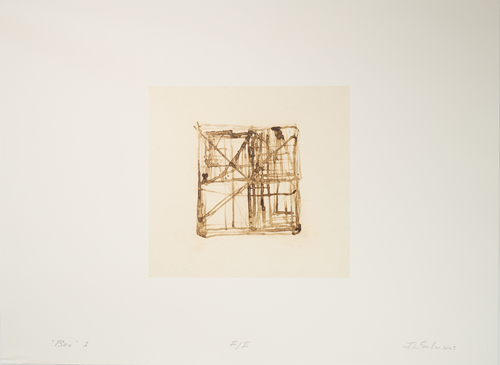
In 2023, Sullivan developed two images at Flatbed to become polymer gravure etchings. First was the image “Box” 1, a hand-drawn skeletal probing of the space of a simple box. He had drawn this image with a certain hand-carved reed dipped in a sepia-toned ink. The second was Popular Mechanics 8 + 3, a diptych intaglio image based on Sullivan's landscape drawings, printed on sheets from a Popular Mechanics magazine with the raised-dot patterns of Braille. The images, though starkly different from each other, share Sullivan’s search for the unseen.
The “Box” 1 drawing began with a drawing of the space and frame of Sullivan’s studio in Wyoming, while at an art residency at Jentel. He sees the drawing as exploring the shallow structure, its space, and the light which joins the inside to the outside. A new direct-to-plate process that transferred the drawing to a light-sensitive plate was used, and the image was etched into the polymer plate. Ink was mixed to be transparent and even more luminous than the drawing, then printed onto a near-square of fine-laid Japan Sekisui paper, which was later colléd to a support paper. It stands complete, in a post-minimalist form, while its interior is active, full of lines that describe its inner boundaries and the spaces between them.
Sullivan’s drawing practice has included drawing with charcoal directly onto Braille sheets from a Popular Mechanics magazine for the blind. The sheets he draws on have wonderful, raised dots that catch the charcoal on one side of the mark and resist on the other. His drawings on these sheets can be read as landscapes that feel like the kind you’d see at deep dusk. They are blind-scapes, perhaps drawn at dusk, when only the minimum light reveals dense and open areas. Using the direct polymer gravure process, two of the drawings were scanned, and etching plates were made that faithfully recorded them and captured the physical texture of the Braille dots. Sullivan made decisions as plates were proved for printing side by side. The plates were selectively inked and wiped to emphasize the subtle tonal contrast between the sky and the tree, and between the tree and the land. The resulting print is a rich tour de force of Braille texture, but the images demand our searching and our experiencing of the landscape of the night.
courtesy of flatbedpress.com/blog/james-sullivan-new-works-in-ink